Sunday, 21 July 2024

Movements: Scotland, conclusion

This is one of my best "out and about" posts ever, in such beautiful and unusual places. 

It had been nearly six years since I was last out and about presenting as fully female. There are lots of reasons for that and I won't go over them again but suffice to say it's been an unsatisfactory situation. My previous post described my trip to Scotland up to the point I flipped and realised that I was sick of being merely a vaguely androgynous visitor and needed to be my real self again. Maybe staying with another transwoman was part of the catalyst, maybe a sense of greater security, maybe the pink fog just became a pink thunderstorm. Or all three.

I mentioned this trip briefly in May but I'd like to record it in more detail. If nothing else, Easter Ross and Sutherland are not a part of the world many people have been to, or even heard of, yet they are very beautiful and we were blessed with lovely spring weather.

Despite initial nerves, which you can imagine after so long out of the limelight, they gave way to excitement. My makeup and hair were not perfect, but OK. It's not like I was going to be on TV! They say there are four seasons in a day in the Highlands so, although the forecast was good, I chose something reasonably pretty for spring - a short floral dress that I've slimmed enough to get back into - but with sensible ankle boots and my faithful M&S Active leggings, which are not so close-fitting as they used to be. I think I need to buy a couple of sizes smaller now. Besides, you can never have too many leggings, I say. I took a fleece and a coat, which were sometimes necessary later. My outfit worked with the weather and locations. Roz is a less chilly mortal than myself and had a knee-length cotton dress on, but she took her smart pink coat too as a precaution.

We headed north, first to Tain, a small market town on the Dornoch Firth on Scotland's East Coast. The first photo was in the high street and this is my first out-and-about picture since 2018!


It's quite a nice little town and the main places to visit are around the local church, dedicated to local saint, Doothac or Doothus (that's Doothus, not Doofus, dear American friends!). 


Here's us two ladies on the "Happy to Chat Bench" in the churchyard.


The rose garden is also pleasant. 


The town's also known for the Glenmorangie whisky distillery, and the inevitable golf course.

Back at the car, a woman carrying a small dog buzzed around us. "I've lost my husband," she declared. We weren't at first sure whether to offer her condolences or take her literally and tut at her carelessness. She resolved the situation by stating, "It's OK, I'm not that bothered," as she wandered off. If only they all took it so well! I was simply pleased that someone interacted with us like any other women.

Onwards and northwards, across the Dornoch Firth ...


... to Dornoch itself, a delightful town with a historic courthouse, Scotland's smallest cathedral and a bishop's castle.


I particularly liked the green Victorian fountain outside the cathedral, with its hidden crocodiles.


The castle is now a hotel which has a lovely beer garden where we had a little bite to eat in the sunshine.


Miss Cheeky Chips

The shady back part of the castle garden was especially pretty.


And then there's the town's Historylinks Museum which packs a huge amount in a tiny space. My favourite bit was the diorama depicting local hero, the Earl of Sutherland, clobbering his Danish antagonist with the leg of a horse! They don't make heroes like that nowadays, that's for sure! Perhaps it's just as well that men are a little less wild today. What the horse thought of this is not recorded.


Food at the castle had been light so at this point I opted to visit local chocolatiers Cocoa Mountain where I indulged in an incredibly sticky croissant and a cup of thick hot chocolate so large and so drizzled with chocolate of all kinds that I have honestly never quite seen its like before. I should have taken a photo as this from their site doesn't do it justice. 


Gender sensible toilets and friendly staff, too. Recommended.

We also went down to the shore where there is a windy golf course and, in a private garden, a stone testifying to the execution of the last person tried for witchcraft in Great Britain. A woman, of course. It's almost always women who are accused of being witches. One Janet Horne, whose daughter suffered from a deformation of hands and feet so that locals accused her mother of having made them that way so she could ride her daughter like a horse at night. How much more enlightened we are now, with just flat earthers and shape-shifting alien lizards for rulers. Mind you, there are all those weird trans people about. Solidarity, sister.


North of Dornoch is Loch Fleet, a small sea loch. But I wanted to stop here as the inspiring Miss Twist had taken a particularly nice photo at this spot.


Then the sun came out properly so the coat came off!

Northwards still to Dunrobin Castle. I wondered if it's pronounced Dunroabin, like Dunroamin, in that the Earl of Sutherland who built it hung up his ermine robe once and for all; but Roz thinks it's pronounced Dunrobbin, which suggests the earl stopped stealing. One of his ancestors certainly purloined horse's legs, so who knows? (NB clan fans: this is all in the pursuit of humour; the honesty of the earls of Sutherland is not impugned.)

Partly unrobed
 

It was almost closing time for the castle itself so we wandered in the leafy park instead.


There were cannons to play with, too.


And on we drove through the old county of Sutherland with its rolling landscape of sheep and buzzards. We passed through Lairg, "crossroads of the North" with its railways station that's almost like an open-air railway museum. The village is also apparently the centre of one of the larges meteorite impact sites on earth. Striking!

We stopped to look across the river at Carbisdale Castle, now owned by trans woman Samantha Kane, Lady Carbisdale, the sort of trans person the British gutter press love to vilify for having dared not only to transition but to detransition and retransition. She owns a castle and a title, so I don't think she's done too badly. The British press really stinks.


And then we drove on to Bonar Bridge, which interested me because of the battles near there in 1650 and 1746, in the Civil War and the Forty-Five Uprising.

And from there to the wonderful views from Struie Hill across the Dornoch Firth. The wind was strong but the spring sunshine really illuminated the landscape.

A view inland

A view seawards, sitting pretty on a wall

Just as well it's a well-worn wig!


The Dornoch Firth and the North Sea beyond

What a wonderful day. And feeling my fem self properly again after all these years.

Many thanks again to my wonderful friend Roz for her hospitality, and to Miss Twist for her pictorial suggestions. For comparison, you can follow the latter's trips, including some of the places I visited, such as Loch Fleet and Loch Ness here, and Eilean Donan Castle here.

The next day I had to go back to the badlands of England so this was my last day in Scotland this time, and it was the best.

Sue x

Thursday, 18 July 2024

Movements: Scotland, part 1

 The highlight of my trip to Britain in May was a week in Scotland where I managed to get out in full female mode for the first time in years. 

I have to thank that witty and informative blogger, Miss Twist, for her inspiration on places to go. If you've not looked at Miss Twist Speaks Her Brains before, I can recommend it for its cosplay antics, psychological insights and girly stances in various beautiful Scottish locations. She made this excellent map with links to her posts describing the various places she's been to and I found it handy for planning my trip. So many thanks to her.

Twistlike pose at Loch Fleet!


1: Edinburgh

But let's begin at the beginning with 24 hours in Edinburgh. I was in Edinburgh five years ago and this time I stayed in the 18th-century New Town but spent much of my time in the Old Town, which I haven't visited in thirty years. It's that old that nothing much changes, not even the tourist tat in the shops in the Royal Mile! But it was interesting wandering round again after so long.


I had a curious breakfast the next day, which included Smarties! That's definitely a first.


I also went to the Royal Scottish Academy to see the annual exhibition, some of which was appealing, some not. That's contemporary art, I guess.


And then I took the train through leafy Perthshire and the Cairgorms to Inverness where I was met by Roz who had picked up the car we had hired for our four-day weekend in the Highlands. 

At her home, Roz's adorable yet bonkers beaver in denim jacket, kilt and necklace was there to greet me, with a glass of Roz's home-brewed beer (very good it was, too).


2: A monster tour of Loch Ness and beyond

I insisted I wanted above all to go to Loch Ness, which I have never been to before. Monster sightings a bonus, but not essential. It's a lovely spot, about as big as Lake Iseo here in Italy, but wilder with few settlements. This is my best picture of Loch Ness, at the SW end near Fort Augustus. I love the way it looks a bit like a watercolour painting. It was actually taken from the car zooming along!


Although we did an entire circuit of the lake that day, we turned off in several places, heading up Glen Shiel and stopping in the dramatic gorge that marks the 1719 battlefield during the Jacobite Rebellions, which was all part of my school A-level history syllabus a very long time ago. Well, not so long after the event, in fact!


Click to enlarge

The Jacobite Uprisings will feature again in this post.

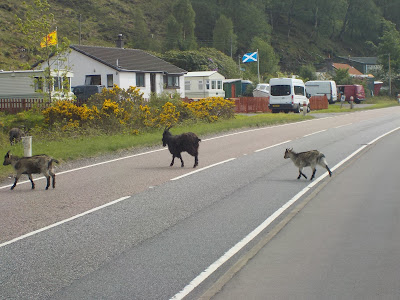
Glen Shiel took us all the way to the west coast at the Kyle of Lochalsh ...


...with its mountain goats ...


...until we got to the famously picturesque Eilean Donan Castle, star of 101 films.


Went went as far as the bridge that now connects the Isle of Skye to the mainland. Our way back brought us to the lumpy landscape of Glen Garry ...

... and the rather nice spot that is the Bridge of Oich on the Caledonian Canal and River Oich.


We took the rougher road that passes south-east of Loch Ness and enjoyed the wide panorama at Suidhe, with its landscape dotted with stone age settlements and its views of lesser lochs, Loch Knockie and Loch Mhor.


The Falls of Foyers, that impressed so many writers of the romantic era, were a little disappointing, but maybe it's not the best time of year. How Roz negotiated the steep climb down in high-heeled sandals, I
don't know. But trans women are superwomen!


Boleskine House is near here, home of mystic Aleister Crowley among others, but is currently closed for repairs. It is, apparently, an unusual place ... as you would expect!

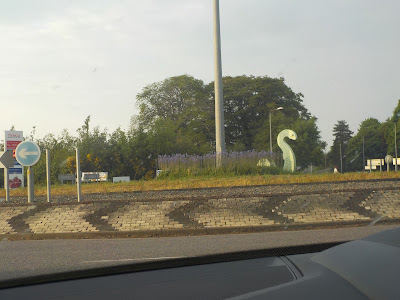
We can't leave this tour of Loch Ness without a picture of the monster, can we?


Well, I guess a sculpture on a roundabout in Inverness will have to do as the real monster didn't show up!

We did a lot of miles that day, I've no idea how many. But what a  fantastic trip, and in perfect spring weather, too.


3: Cromarty

I also wanted to see Cromarty at the tip of the Black Isle. It's a nice example of a Georgian town; was once the county town of the oddest, most scattered county in the British Isles, Cromartyshire; and was the birthplace of Thomas Urquhart, a hero to linguists such as myself. It's a lovely town, with a very arty feel to it: the arthouse cinema, craft shops and exhibitions, the slaughterhouse repurposed as a coffee shop!...


Despite the offputting name, they do good coffee, and have a cosy fireplace.

The Cromarty Firth is where oil rigs go to die. Here's an atmospheric shot.


The town has reinvented itself as a cultural centre following much emigration. The poignant monument to that emigration stands on the shore looking towards the opening of the Cromarty Firth to the sea and the world beyond. 


It was at the Old Courthouse Museum that I enquired more closely about Sir Thomas Urquhart and the custodian went to the library cupboard and brought out copies of just about every book written about him and most of his works. I was stunned, so I took a few notes and will go back one day and look at them properly. Many thanks to the helpful and kind member of staff who showed me the stuff that's not normally on display.


Next door is Hugh Miller's Cottage, with it's pleasant garden, which in turn has a fairy garden!


I insisted we also go and see the so-called pirates' graveyard. So-called not because any known pirates were buried there but because the 17th and 18th-century tombs have a recurring skull and crossbones motif. Here are just a few of the fancier ones.


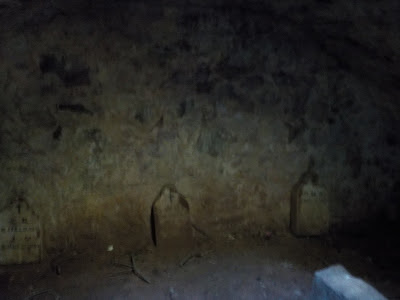
There's also an unusual and creepy crypt buried right under the turf.


Thankfully, they've put a grille over the open hole that lets a bit of light in. They wouldn't want someone falling in to their own death ... or would they?


Jinkies, Scoob! Sure is creepy! As is the tunnel that was used by servants to get to Cromarty House. You wouldn't want the staff using the main gate along with the Quality now, would you?


Anyway, I thought Cromarty was a fascinating and charming town. The Black Isle peninsula
in which it is located is a pleasant farming landscape, and which we drove around to Rosemarkie with its views up and down the Moray Firth and across to Fort George, another testament to the Jacobite Uprisings.

Moray Firth and Black Isle

Vast Fort George, built at great expense between 1748 and 1769, on the opposite shore of the Moray Firth
 

We didn't have time to go to Fort George but did enjoy a little time in Fortrose with its ruined cathedral.

That was a very interesting day in lovely, lesser-known places. We finished up at the award-winning Fyrish Tandoor in Alness. Indian restaurants are almost unknown in Italy so I make the most of the opportunities when I'm in Britain. My sizzling lamb shashlik was very good, I have to say. 


4: Culloden

I end this part of the trip with our day at Culloden Battlefield where the Jacobites met their final end after 60 years of sporadic civil war. It's complex history and if you really want to delve into it, here's the Wikipedia entry on Jacobitism, or you could go to the outstanding visitor centre on Drummossie Moor east of Inverness, as we did.

Roz knows one of the guides, Iona, and we booked her tour of the battlefield. The National Trust for Scotland owns about half the battlefield and has marked the opposing lines carefully with flags and information boards, and they are allowing the ground to revert from farmland back to bog, which was instrumental in the failure of the Jacobite charge on that fateful day in 1746.

The opposing lines at the start of the battle are clearly marked with paths and red flags for the government forces ...


... and blue flags for the Jacobite forces ...


As museum battlefields go, this is very well marked out and anyone can follow the action, and the aftermath.


I recommend it as a place to visit. The attached museum with documents and artifacts is very good, the café is nice and there is a huge car park. Iona, our guide, was super well-infomed, too.

Get this lady to guide you if you can.


I guess I've always had Jacobite sympathies. I'm not so convinced by all these Germans who've been on the British throne for 300 years. Or did the trouble start with the Normans? Or maybe the Danes? Mind you, the Romans really carved things up... Still, we visit historic sites so that we can see ...how the world constantly fails to learn the lessons of history. 

So Loch Ness, Cromarty and Culloden were three things to tick off my bucket list. Rather than extending this post with my final full day with Roz, I'll use the next post to describe in more detail the trip to the far north that I took fully en femme, my first Sue outing in six years.

Thanks for reading.

Sue x


Friday, 12 July 2024

The Pride tram, rebel witches and weird food

 I'm away from home for a few days and have gone to Milan because of the good shopping to be done there, and for a bit of culture and eating out. Yes, the diet is on hold while I munch my way through some very interesting dishes. Traditional local food uses some weird cuts of meat, like beef shank sinews ("nervetti") and sweetbread (veal pancreas) and I'm not sure I can recommend them, but there's compensation in good pizzas and a wide variety of foreign restaurants. Last night's Spanish tapas were amazing, as was the cava to wash them down.

I've also been making photos and short films of the very old trams here. I've mentioned these before, but the backbone of the Milan tram fleet is still made up of the 1928 model streetcar that is still in daily use on half a dozen routes. I think it worth recording these because they will eventually be retired, and because one beloved trans friend of mine has a passion for trams so she'll want to see them. A trans tram fan! But I was delighted when one painted in Pride colours happened to trundle past on Route 1. Pride month is over but this will presumably not be repainted to standard livery for a while yet as it costs money so we have a moving Pride advert for the time being! 


I was pleased to hear that a whole subway train in Rome was similarly decked out this year.

Another local thing is a passion for artistic decks of playing cards, either normal 52 card decks or traditional Italian decks, which have different suits and usually only 40 cards, or tarot cards, and so forth. Lots of artists are commissioned to do their own take. I got a friend a present of a set of tarot cards depicting "rebel witches", i.e. nonconformists including a lot of LGBT icons like Ziggy Stardust, Ursula Le Guin, generic lesbian lovers, etc. I think they'll appeal to her.


Unrelated, but it's worth mentioning an unusual sight on the train here, which is the mile upon mile of paddy fields around Pavia where they grow Italian strains of rice. The crop is not full grown yet and is a brilliant green, poking up from the muddy water. Posted every fifty yards or so is a small white heron waiting for little fish and frogs to make the mistake of passing by. It's an unusual but attractive sight. Risotto with fried frogs is a local dish in that area, both ingredients coming from the same field. 

And we're back to odd food again! It's a bit of a fixation!

Have a good summer.

Sue x

Sunday, 7 July 2024

Transgender arts and culture, summer 2024

 There are lots of cultural events and art shows with a trans flavour this summer. I won't be able to comment on them all in one post so here to start with are the two big ones ... and a more personal note of interest.


The Expressionists, London

Let's start with Tate Modern in London, which has a major exhibition on "The Expressionists: Kandinsky, Münter and the Blue Rider", which I went to see with a couple of friends in May. I'm not sure it was really my thing (and the £22 entry fee certainly wasn't!) but the record of the crossdressing performances of Alexander Sacharoff certainly were (Room 5: performing gender). Marianne Werefkin's striking 1909 portrait of Sacharoff is one of the exhibition's icons.


The exhibition describes these artists' gender outlook as follows:

Traditionally, theatre and performance offered safe environments for the exploration of sexuality and gender. Performers could switch gender and power roles, and engage with transgressive themes. Artist and patron Werefkin was attracted to the free arts of street theatre and popular entertainment for their freedom of expression and potential to disrupt the highly regulated social structures women were confined to.

Werefkin experimented with expressionist painting while also grappling with questions of identity. This included navigating the legal and social barriers of gender inequality. Her privileged upbringing and financial independence allowed Werefkin to assume a position of power, acting as patron and supporter of the arts – a field traditionally monopolised by men. In this period, such women were given the pejorative label ‘manwoman’ to denote their being ‘unnatural’, members of a ‘third sex’. This perspective was critically explored in the writing of contemporary philosopher and minority rights activist Johannes Holzmann.

Resenting gender binaries, Werefkin stated: ‘I am not a man, I am not a woman, I am I.’ She shared affinities with artists challenging traditional gender roles. This is reflected in her support of performer Sacharoff. Presenting androgynously both on and off stage, Sacharoff explored gender fluidity through new styles of performance that activated form through free movement. Believing that dance resembled music or painting, Sacharoff said: ‘In the art of dance the body must be an elaborate instrument capable of expressing the soul. In this sense, it must be as valid as the word, the sound and the colour’. Performance was central to both Werefkin and Sacharoff’s investigations and constructions of self-identity.


Some photos of Sacharoff's performances are here:


To be honest, though, it was August Macke's paintings of ladies enjoying the displays in milliners shops that appealed most to me!


Venice Biennale, Italy

The Venice Biennale is a contemporary art exhibition that dates back to 1895. The theme for 2024 is "strangers everywhere", focusing on art outside the mainstream, such as the art of lesser known cultures and queer art. The connection between the words strange and queer here is not accidental.

Trans or gender varied works and artists include:

trans man Rindon Johnson; 

non-binary artist Shalom Kufakwatenzi;

Electric Dress and A Sculpture for Trans Women by Puppies Puppies; 

Black Men in Dress by photographer Sabelo Mlangeni;

the mixed-gender, cigar-chomping skirt-sporting traditional Ekeke figure by Violeta Quispe;

and a degree of gender mixing in the Fashion Girl sculpture by Taylor Nkomo.


Other queer art at the Biennale that seems especially noted by the art press includes works by:

Omar Mismar from Lebanon and his paintings of male couples in the style of Greek mosaics;

Louis Fratino from the USA and his modern gay take on Picasso's Demoiselles d'Avignon;

Xiyadie from China, a gay farmer, explicit yet not, who mingles nature with humans aroused;

Salman Toor from Pakistan and his scenes of everyday life in the queer community.


Nearer to home

I find that my brother-in-law is actually a keen collector of contemporary art, a lot of which is quite fun (such as ceramic space invaders by Invader, who had a major exhibition in Paris earlier this year). He doesn't necessarily keep any item long but aims to sell it on. But he was quite excited about a piece by everyone's favourite crossdressing contemporary potter, Grayson Perry. It must have cost him a lot so I hope he gets a good return on his investment! But he was saying what he thought of Perry, aka Claire, and just accepted the alter ego as a necessary part of the artist's persona and production. The art world is very accepting of gender difference, as I found myself when participating in shows as Sue and I'm glad my brother in law is no bigot, which is more than can be said for the rest of my family.


Queer art from early twentieth and the early twenty-first centuries, then. More soon. 


A dip in the archives

I haven't dipped in the archives for a while but, for those interested in Grayson Perry, I saw work of his at the Photographers Gallery in London in 2018 with my friend Ange: Photography exhibition.

I also saw his less enthusiastically reviewed show, Provincial Punk, in Margate in 2015. Here's the review of that exhibition in The Independent.

Sue x

Wednesday, 3 July 2024

Voting with my feet

 There are many significant elections in 2024. Tomorrow is the UK national election and the current government is universally predicted to lose. 

That government has caused me so many significant problems that, although I was living - and expected to live - my life in the United Kingdom, I felt compelled to leave in 2018. 

I now live in Italy. That's partly for health reasons since the naturally grey, dank climate of the British Isles was causing me many problems, but also for the significant economic damage, xenophobic abuse and now transphobia that has been pushed on me by that government since 2016. Italy afforded me a path to alternative citizenship through a very old law of theirs that anyone who has had an Italian ancestor from 1860 onwards is automatically an Italian, too. That connection merely has to be proved with suitable documentation. Thanks to Italian emigration in the last 165 years, a significant proportion of the world is now Italian! That's why pizza is the world's favourite food, right? Check your ancestry to tap into any benefits. Anyway, that was my ticket out of that hate-filled chaos of Brexit, the UK's crass, corrupt handling of the Covid pandemic, and the current brazen transphobia there. Italy has an officially extreme right-wing government now ... but one that's essentially pro-democracy, pro-Europe, pro-NATO, upholds the rule of law, constitutional arrangements and rights. Unlike the UK government that is so extreme it has seriously considered leaving the UN, human rights organisations and courts, and is frothingly enraged by vulnerable boat people, and by any organisation with "European" in its title, such as the European Atomic Energy Agency ...that oversees power stations!

This extremist insanity has been countered since 2016 not by reason or concerted opposition but by the government's own incompetence. The government has been made up largely of people educated in Britain's private education system (which is, with typical British perversity, known as the public school system), the chief function of which is to give its protegés the aura of competence in command and a right to rule but without providing them with any practical know-how at all. And it is only this failing that has prevented the UK from becoming a new Nazi state, though it came close with Boris Johnson's coup-like antics in 2019. Hitler, by contrast, was not an unimaginative guffawing dimwit, which is why his destructiveness was universal, not merely local.

It is beyond my understanding how a new government is to combat the corruption and criminality left by the outgoing one; the cost of living crisis; the decades-old housing crisis; the financial strains and damage of Brexit isolation; the ongoing banking crisis recession; the loss of international reputation because of the visible incompetence of the last few years; the ownership of much British public and private estate by private equity, shell companies in tax havens and foreign investors; the extreme right-wing leanings of most of the few owners of Britain's media and their corruption of the once politically neutral BBC; and all the other challenges of the 21st century for a country that has a constitution forged in 1689. I'm out of it and am glad to be so. Life in Europe has its complexities, stresses and problems, but nothing like as bad. I feel safer and less put upon. Trans rights are not very developed in Italy but they are not, so far, under that much threat. When I started this blog 13 years ago, Britain was progressing with trans rights, now it's regressing and the Labour Party leadership that is widely tipped to win tomorrow has said that it intends to accept many findings of the recent dishonest Cass report. The UK is a worsening place for trans people now.

When I went back to Britain in May I did renew my UK passport. That's simply to save hassle at the border after the harder effects of Brexit come into effect in due course (Brexit hasn't been fully implemented yet, you see.) But my Italian passport has more value and clout in the world than the UK one right now. How are the mighty fallen.


Incidentally, the UK government made a huge fuss about the return to blue passports after the years of European ones in plum colour. My UK one is unequivocally black, or 'blackshirt' as I call it. They couldn't even get a colour right! Or manufacture the passports in Britain (they are made in Poland, an ongoing member of the European Union). 

So I don't greatly care what the outcome of the election is tomorrow, although the eradication of the current malignant government that has caused me so much direct harm would give me some pleasure for a few hours on Friday. I'm staying in Europe now, like the hundreds of thousands of other Brits who've left and sought a life and citizenship elsewhere. Human rights, liberty and peace are essential to me. I will go where they can be found. The crazed state of the world scares me right now but I have my passports and I will go where it is safe. I hope you may find the safety to live peacefully, too.

Sue x